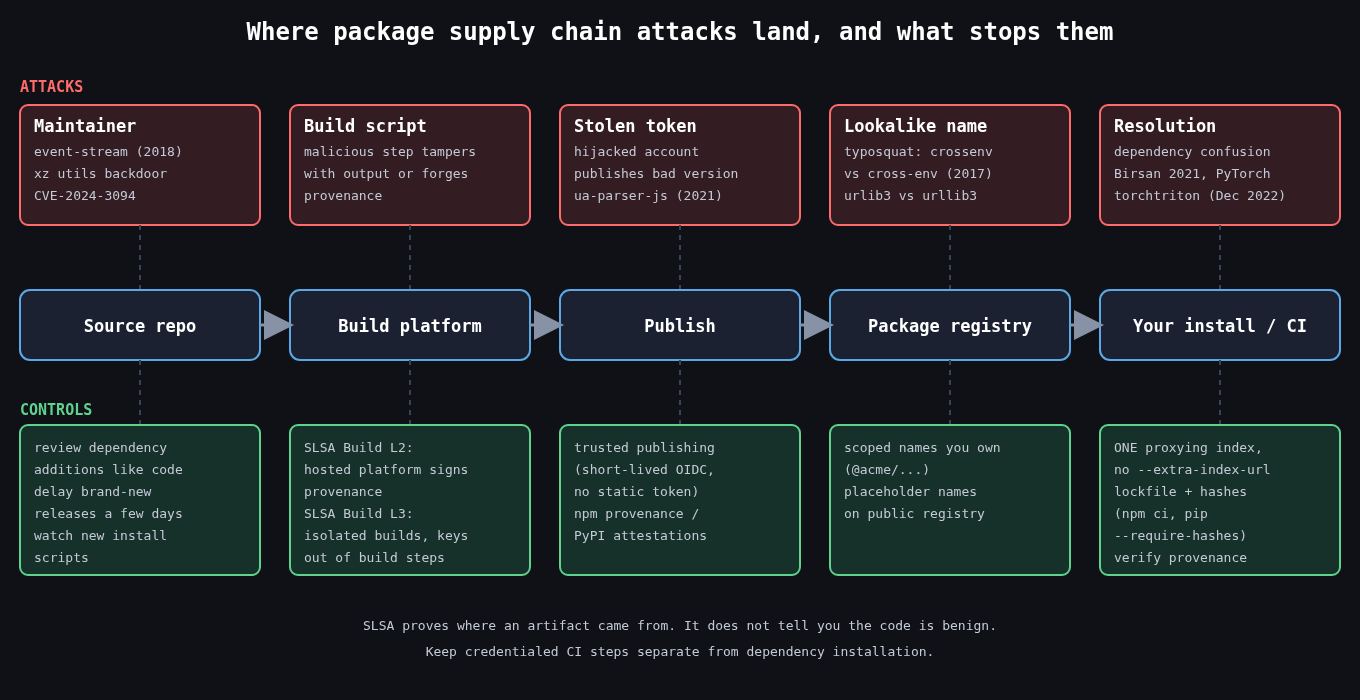
Every npm install or pip install is a decision to run someone else’s code with your build’s permissions. Most of the time that’s a good trade. The attacks I want to cover here don’t exploit a bug in your code at all. They exploit how package managers decide which package to fetch, and how little most organisations know about where their artifacts came from.
Typosquatting is boring and still works
The oldest trick is publishing a package with a name one keystroke away from a popular one. In 2017 an npm package called crossenv (the real one is cross-env) copied the legitimate package’s behaviour and also sent the contents of the environment to a remote server. Environment variables on a CI runner are often the most valuable thing on the box: registry tokens, cloud credentials, signing keys. The same year Slovakia’s national security authority reported a batch of typosquats on PyPI with names like urlib3, and PyPI has been removing waves of them ever since.
The registry operators catch a lot of these now, but not before someone installs them. The defences on your side are unglamorous. Don’t let people add dependencies by typing names into a terminal on a machine that holds credentials. Review dependency additions in pull requests the same way you review code, and look at the package’s age, download count and repository link before approving it. A two week old package with a name almost matching a library with millions of weekly downloads should not get through review.
Dependency confusion
Alex Birsan’s February 2021 research turned a quirk of package resolution into a way to run code inside Apple, Microsoft, PayPal and over thirty other companies, earning more than $130,000 in bug bounties. The idea is simple. Companies use internal package names that never exist on the public registry. Those names leak through public manifests, JavaScript bundles and error messages. If an attacker publishes a public package with the same name and a higher version number, many resolvers happily prefer it.
--extra-index-url doesn’t mean “fall back to PyPI if the internal index doesn’t have it”. pip collects candidates from every index and picks the best version across all of them. If someone publishes acme-billing-utils 99.0.0 on PyPI, that’s what gets installed.
This wasn’t a one-off. In December 2022 the PyTorch project disclosed that its nightly builds installed between December 25 and 30 had pulled a malicious torchtriton package from PyPI, because the legitimate one lived on PyTorch’s own index and PyPI took precedence. The malicious version collected system information and files from the machines that installed it.
The structural fix is to have exactly one place your builds resolve from. Run a proxying repository (Artifactory, Nexus, a pull-through cache) that serves internal packages and mirrors public ones, and configure it so an internal name can never be satisfied from upstream. For npm, put internal packages under a scope you own and pin that scope to your registry:
Registering your internal names (or scope) on the public registry as empty placeholders is a reasonable extra layer, but I wouldn’t rely on it alone.
Lockfiles and hashes
A lockfile pins exact versions, and the integrity hashes in it pin exact bytes. That turns “install whatever matches ^4.2” into “install this tarball and fail if it’s different”. Use npm ci rather than npm install in CI, since ci refuses to proceed if package-lock.json and package.json disagree. For Python, pip’s hash checking mode does the same thing:
pip install --require-hashes -r requirements.txt
with each line carrying --hash=sha256:..., which tools like pip-compile --generate-hashes produce. Hashes don’t protect you on the day you add or upgrade a dependency. They do stop a later build from silently picking up something different.
Compromised maintainers
Some attacks don’t need a lookalike name. In 2018 the maintainer of event-stream handed the project to a volunteer, who added a dependency called flatmap-stream carrying code aimed at stealing from a specific cryptocurrency wallet app. In October 2021 the npm account behind ua-parser-js was hijacked and versions shipping a cryptominer and credential stealer were published. And in 2024, CVE-2024-3094 showed a backdoor in xz utils that had been inserted after a multi-year effort to gain maintainer trust, caught largely because one engineer noticed SSH logins getting slower.
Nothing on the consumer side fully prevents this, but you can shrink the window. Delay adopting brand new versions by a few days unless they fix something you need, because most malicious releases are spotted and pulled quickly. Watch for install scripts (preinstall, postinstall) appearing in packages that never had them, and consider npm config set ignore-scripts true for builds that don’t need them.
What SLSA requires
SLSA (Supply-chain Levels for Software Artifacts) is easy to misread as a scanning standard. It’s not. Version 1.0’s Build track is about provenance: a verifiable statement of which source, which build platform and which process produced an artifact.
The levels build on each other. Build L1 means provenance exists and describes how the artifact was built. Build L2 means the build ran on a hosted platform that generates and signs that provenance itself, so a developer laptop can’t produce it. Build L3 means the platform is hardened: builds are isolated from each other, and the signing material is out of reach of the user-defined build steps, so even a malicious build script can’t forge provenance.
What SLSA does not do is tell you whether a dependency is trustworthy. It lets a consumer check that a package came from the repository and workflow it claims to, which is exactly what you want to know after an account takeover. On the publishing side, PyPI’s Trusted Publishing and npm’s provenance support both bind packages to a specific CI workflow using short lived OIDC credentials instead of long lived API tokens. On the consuming side you verify:
I’d prioritise it this way. Get to one resolution source and committed lockfiles with hashes first, because that kills dependency confusion and drift. Move your own publishing to trusted publishing so there’s no static token to steal. Then start verifying provenance for the dependencies that matter most, beginning with anything that runs in your build or release pipeline.
The part people skip
Your build environment is part of the supply chain. A CI job that installs packages while holding production deploy credentials gives every one of those packages production access. Split dependency installation from credentialed steps where you can, give build jobs only the secrets they need, and treat a compromised dependency the same as a compromised server: rotate what it could reach, don’t just bump the version.
The increasing prevalence of software supply chain attacks, exemplified by incidents such as SolarWinds (2020) and xz-utils (2024), has intensified scrutiny of software distribution mechanisms and build infrastructure integrity. This paper examines Gentoo Linux as a source-based distribution model that addresses fundamental supply chain security concerns through local compilation, transparent build processes, and granular system configuration. Drawing upon academic literature in software supply chain security, reproducible builds research, and memory protection mechanisms, this analysis evaluates the technical advantages of source-based compilation for enterprise environments where security posture, auditability, and performance optimization are paramount considerations. The findings suggest that while source-based distributions require greater administrative investment, they provide security and transparency guarantees that binary distributions cannot achieve without substantial modification.
Software supply chain security has emerged as a critical concern in contemporary computing environments. Okafor et al. (2024) identify four stages of supply chain attacks and propose transparency, validity, and separation as essential security properties for defending against such threats. The 2020 SolarWinds compromise demonstrated the catastrophic potential of build infrastructure attacks, affecting over 18,000 organizations through trojanized software updates (CrowdStrike, 2021). More recently, the xz-utils backdoor (2024) revealed vulnerabilities in the trust relationships underlying open-source software maintenance.
These incidents underscore a fundamental tension in software distribution: the convenience of pre-compiled binary packages necessitates implicit trust in vendor build infrastructure, signing processes, and internal security controls. Lamb and Zacchiroli (2022) observe that reproducible builds provide a foundation for defending against arbitrary build system attacks by ensuring that identical source code, build environment, and instructions produce bitwise-identical artifacts. Source-based distributions such as Gentoo Linux implement this principle by design, compiling software locally from auditable source code.
This paper examines the technical characteristics of Gentoo Linux that position it as a compelling choice for security-conscious enterprise deployments. The analysis draws upon peer-reviewed research in software supply chain security, memory protection mechanisms, and compiler optimization to evaluate the advantages and operational considerations of source-based distribution models.
2. Core Capabilities and Enterprise Implications
Table 1 summarizes Gentoo’s core capabilities and their relevance to enterprise environments.
Capability
Enterprise Implication
Supporting Evidence
Source-Based Build System
Compile each package with user-defined options, enabling hardware-specific optimization and security hardening
Lamb & Zacchiroli (2022) demonstrate that local compilation enables verification of build processes
Portage Package Manager
Declarative dependency resolution, atomic updates, rollback support via --with-bdeps=y option
Gentoo Wiki (2024) documents transaction semantics for dependency-aware upgrades
Rolling Release Model
Continuous integration of security patches without disruptive major version upgrades
Eliminates accumulation of technical debt between point releases
Minimal Footprint
Only user-requested packages are installed; no pre-bundled services
Reduces attack surface per principle of least privilege
Reproducible Builds
Build scripts capture exact compiler flags, environment variables, and dependencies
Miller et al. (2020) validate reproducibility across multiple host machines
Customizable Kernel
Full control over kernel configuration and module selection
Enables hardware-specific optimizations and removal of unnecessary subsystems
3. Software Supply Chain Security and Build Integrity
3.1 The Build Infrastructure Attack Surface
Cox (2024) notes that the integrity of software builds is fundamental to supply chain security, observing that while Thompson first raised the potential for attacks on build infrastructure in 1984, limited attention was given to build integrity for the subsequent four decades. The SolarWinds attack demonstrated the practical realization of these theoretical concerns: the SUNSPOT malware was specifically designed to inject the SUNBURST backdoor during the compilation process without arousing suspicion from development teams (CrowdStrike, 2021).
Binary distributions inherit this vulnerability by design. When organizations deploy pre-compiled packages, they implicitly trust that the vendor’s build environment was not compromised, that no malicious modifications occurred during compilation, and that signing keys were not misused. As Fourné et al. (2023) observe, the software industry places substantial trust in build systems, yet this trust is often unverified and difficult to validate.
3.2 Local Compilation as a Security Control
Source-based distributions address build integrity concerns by shifting compilation to the local environment. When software is compiled from source, the trust boundary contracts significantly: organizations need only verify the integrity of upstream source archives (typically through cryptographic signatures) rather than trusting an entire build pipeline operated by third parties.
Gentoo’s package management system (Portage) implements this model through ebuilds—human-readable shell scripts that document the complete build process, dependencies, and configuration options. This transparency enables security teams to audit package build procedures, understand software behavior before deployment, and verify that compilation adheres to organizational security policies (Gentoo Wiki, 2024).
Lamb and Zacchiroli (2022) emphasize that reproducible builds increase the integrity of software supply chains by enabling end-users to establish trust in executables even when built by untrusted third parties. While achieving perfect reproducibility requires addressing sources of non-determinism such as timestamps and path dependencies, Gentoo’s source-based model provides the foundation for implementing reproducible build practices when required.
4. Hardened Compilation and Memory Protection
4.1 Position-Independent Executables and ASLR
Address Space Layout Randomization (ASLR) represents a fundamental defense against memory corruption exploits. Shacham et al. (2004) conducted foundational research on ASLR effectiveness, demonstrating that security is increased by increasing the entropy in random offsets. The PaX project, which first implemented ASLR for Linux in 2001, documented that randomizing the positions of code, data, heap, and stack segments significantly complicates exploitation of buffer overflow vulnerabilities.
ASLR effectiveness depends critically on Position-Independent Executables (PIE) compilation. As the Gentoo Hardened documentation explains, standard executables have fixed base addresses and must be loaded to these addresses to execute correctly. PIE compilation enables the executable itself to be loaded at a random address, providing the same address randomization to the main binary as to shared libraries (Gentoo Wiki, 2024).
Marco-Gisbert and Ripoll (2019) propose ASLR-NG, demonstrating that implementation details significantly affect ASLR security properties. Their analysis revealed weaknesses in 32-bit implementations and correlation attacks that reduce effective entropy. Gentoo’s hardened profiles enable administrators to implement PIE compilation system-wide, ensuring consistent ASLR effectiveness across all locally-compiled binaries rather than relying on vendor decisions about which packages merit hardening.
4.2 Stack Smashing Protection
Stack Smashing Protection (SSP), originally developed as ProPolice by Dr. Hiroaki Etoh at IBM, attempts to detect and prevent stack buffer overflow attacks. The protection mechanism inserts canary values between local variables and return addresses; if an attacker overwrites the return address through a buffer overflow, the canary modification is detected before the corrupted return address is used (Gentoo Wiki, 2024).
The Gentoo hardened toolchain implements SSP through compiler patches and configuration that enable these protections by default. SSP is a critical component of the overall hardened strategy: while PaX prevents stack overflows from being executable, SSP prevents attacks that alter program flow by modifying return addresses (Gentoo Wiki, 2024).
4.3 System-Wide Hardening Through Profile Selection
Binary distributions typically apply hardened compilation selectively, targeting only packages deemed security-critical. This approach leaves substantial portions of the system compiled without exploit mitigations. Gentoo’s profile system enables system-wide application of hardened compilation flags, ensuring consistent security properties across all locally-built software.
The Hardened Gentoo project provides profiles that configure the toolchain (GCC, binutils, glibc) to produce hardened binaries by default. By selecting a hardened profile and rebuilding the system, administrators ensure that all packages—not merely those the distribution vendor deemed worthy of hardening—benefit from PIE, SSP, RELRO, and other exploit mitigation techniques (Gentoo Project:Hardened, 2024).
5. Attack Surface Reduction Through USE Flags
The principle of least privilege extends beyond access control to encompass code presence: functionality that is not compiled into a system cannot be exploited. Gentoo’s USE flag system provides a mechanism for controlling optional features across the entire package ecosystem, enabling systematic attack surface reduction.
5.1 Feature Exclusion at Compile Time
Binary distributions compile packages with extensive feature sets to satisfy diverse user requirements. A typical server deployment may include support for graphical interfaces, legacy protocols, debugging symbols, and compatibility layers—none of which serve the system’s operational purpose but all of which represent potential attack vectors.
USE flags enable administrators to systematically exclude unnecessary functionality:
Headless servers: Disabling X11 support (-X) removes graphical toolkit dependencies
Security-focused builds: Disabling JIT compilation (-jit) eliminates writable-executable memory regions
Minimal installations: Disabling Bluetooth (-bluetooth), CUPS (-cups), or other irrelevant subsystems
5.2 Security-Relevant USE Flag Propagation
USE flags propagate through the dependency tree, ensuring consistent behavior system-wide. This consistency is particularly valuable for compliance requirements. Organizations subject to regulatory frameworks (FedRAMP, HIPAA, PCI-DSS) can enforce cryptographic standards, exclude specific libraries with licensing concerns, or ensure that all packages utilize approved authentication mechanisms through USE flag configuration rather than post-hoc verification of binary contents.
6. Hardware-Specific Compilation and Performance
Binary distributions must compile packages for the lowest common denominator of supported hardware. A package targeting generic x86-64 cannot utilize AVX-512 instructions, advanced prefetching, or processor-specific optimizations available on modern enterprise hardware. The GCC documentation describes the -march flag as instructing the compiler to produce code for a specific processor architecture, enabling use of all capabilities, features, instruction sets, and quirks of the target CPU (GCC Manual, 2024).
6.1 Instruction Set Optimization
Modern x86-64 processors implement multiple generations of vector instruction sets: SSE, AVX, AVX2, and AVX-512. Each generation provides wider registers and additional operations that can significantly accelerate compute-intensive workloads. The Gentoo GCC optimization guide notes that the -march flag specifies which instruction set architecture (ISA) the compiler may use, enabling generation of code that exploits these capabilities (Gentoo Wiki, 2024).
For organizations operating high-performance computing clusters, machine learning inference pipelines, or cryptographic workloads, the performance differential between generic and optimized compilation can be substantial. Goedecker (2023) demonstrates that appropriate use of compiler flags can significantly enhance performance, particularly for floating-point intensive operations that benefit from SIMD vectorization.
6.2 Link-Time Optimization
Link-Time Optimization (LTO) enables the compiler to perform whole-program optimization across translation unit boundaries. Godbolt (2020) observes that LTO allows function bodies to be moved from headers to implementation files while preserving optimization opportunities, reducing coupling and compile-time dependencies without sacrificing performance.
Source-based compilation enables organizations to selectively apply LTO to performance-critical packages, balancing compilation time against runtime efficiency based on operational requirements rather than distribution vendor priorities.
7. Enterprise Integration and Operations
7.1 Configuration Management Integration
Modern enterprise environments rely on infrastructure-as-code (IaC) practices for consistent, auditable system management. Portage can be integrated with configuration management tools including Chef, Puppet, Ansible, and SaltStack to enforce consistent system state across server fleets. This integration enables:
Declarative specification of installed packages and USE flags
Version-controlled system configurations
Automated compliance verification
Reproducible deployments across environments
The combination of Portage’s explicit configuration model with configuration management tooling provides audit trails that satisfy enterprise compliance requirements.
7.2 Rolling Release and Continuous Security Updates
Point-release distributions implement a cadence of major version upgrades that introduce substantial changes simultaneously. These upgrade events accumulate technical debt, create testing burdens, and introduce risks of incompatibility. Gentoo’s rolling release model eliminates discrete major upgrades in favor of continuous incremental updates.
Rapid Vulnerability Response: When security vulnerabilities are disclosed, source-based distributions enable immediate rebuilding against patched source code. Organizations using binary distributions must wait for vendor build, testing, and mirror synchronization processes—delays that extend exposure windows for zero-day vulnerabilities. The xz-utils backdoor discovery in 2024 demonstrated this advantage: source-based systems could immediately rebuild against known-good source versions while binary distributions required waiting for new package releases.
Granular Update Control: Gentoo’s keyword system (stable versus testing) provides granular control over update aggressiveness on a per-package basis. Organizations can accept newer versions of less critical components while maintaining conservative policies for security-sensitive packages—a flexibility that point-release distributions cannot readily provide. Automated updates can be managed via emerge -uDN @world combined with scheduling tools such as Cron or Ansible Playbooks.
7.3 Legacy Software Compatibility
Enterprise environments frequently require maintenance of legacy applications with specific library or runtime dependencies. Gentoo addresses this through:
Slot system: Multiple versions of packages (e.g., Python 2.7 and Python 3.x) can coexist without conflicts
Custom overlays: Enterprise-specific patches or proprietary packages can be maintained in private overlays, isolated from upstream changes
Preserved libraries: The preserve-libs feature maintains old library versions during upgrades until dependent packages are rebuilt
These mechanisms enable organizations to maintain legacy applications while continuing to update the broader system.
8. Economic Considerations
8.1 Licensing and Subscription Costs
Gentoo is released under the GNU General Public License v2, eliminating per-node subscription costs associated with commercial Linux distributions. For organizations operating large server fleets, the absence of licensing fees can represent substantial savings. However, this analysis must account for the total cost of ownership, including administrative overhead and infrastructure requirements.
8.2 Hardware Efficiency
Optimized builds can reduce RAM and storage requirements per node. Systems compiled with only required functionality consume fewer resources than general-purpose binary distributions, potentially enabling higher consolidation ratios in virtualized environments or extending the useful life of existing hardware.
8.3 Maintenance Model
Rolling releases distribute maintenance effort continuously rather than concentrating it in disruptive major upgrade projects. While this requires ongoing attention, it eliminates the resource-intensive upgrade cycles that point-release distributions impose every few years.
9. Enterprise Use Cases
Table 2 summarizes deployment scenarios where source-based distribution characteristics provide particular advantages.
Clusters compiled with -march=native -O3 -mtune=native for maximum throughput
Enterprise Virtualization
Minimal footprint, fast installation, custom kernel modules for hypervisor integration
KVM hosts with minimal Gentoo install plus kvm-intel and qemu-kvm modules
Security Appliances
Full source inspection, reproducible builds, minimal base system
Custom firewall appliance with iptables, fail2ban, clamav; signed artifacts in secure repository
Embedded and IoT
Small binaries, cross-compile toolchains, deterministic builds
Cross-compiling Gentoo target for ARM Cortex-A53 sensor gateway
Compliance-Heavy Environments
Audit-ready build process, signed artifacts, minimal attack surface
Financial services firm building signed, verified Gentoo images for branch servers
10. Addressing Operational Concerns
Table 3 addresses common concerns regarding source-based distribution adoption in enterprise environments.
Concern
Mitigation Strategy
Implementation
Learning Curve
Staged rollout with automation and training
Use installation media (Gentoo LiveGUI) to bootstrap “golden” server images, then replicate via configuration management
Compilation Time
Binary packages, distributed compilation, caching
Compile once on build servers using binpkg; deploy binary packages to fleet. Use distcc for distributed compilation and ccache for compiler caching
Update Management
Automated updates with monitoring
Schedule emerge -uDN @world via Cron or Ansible; implement audit-log capture for change tracking
Commercial Support
Third-party support contracts
Engage vendors offering Gentoo-specific managed services or enterprise support agreements
Legacy Software
Overlays and slots
Maintain custom overlays for in-house tools; use slots for multiple library versions
11. Conclusion
The software supply chain attacks of recent years have demonstrated the vulnerability inherent in trusting binary distributions compiled by third parties. Gentoo Linux’s source-based model addresses this vulnerability through local compilation, transparent build processes, and granular configuration control.
The hardened compilation capabilities—PIE, SSP, RELRO, and related exploit mitigations—can be applied system-wide rather than selectively. The USE flag system enables attack surface reduction at a level of granularity unavailable in binary distributions. The rolling release model aligns with continuous deployment practices while enabling rapid vulnerability response.
These advantages require operational investment in expertise and compilation infrastructure. Organizations must evaluate whether the security and transparency benefits justify this investment given their specific threat models, compliance requirements, and operational capabilities. For environments where security posture is paramount—critical infrastructure, defense systems, financial services, healthcare—the case for source-based distribution merits serious consideration.
Future research directions include quantitative analysis of compilation time overhead in enterprise environments, comparative security assessment of hardened versus standard distribution deployments, and development of automated tooling for compliance verification of source-based system configurations.
References
Cox, R. (2024). Fifty years of open source software supply chain security. ACM Queue. https://queue.acm.org/detail.cfm?id=3722542
CrowdStrike. (2021). SUNSPOT malware: A technical analysis. CrowdStrike Blog. https://www.crowdstrike.com/blog/sunspot-malware-technical-analysis/
Fourné, M., Wermke, D., Enck, W., Fahl, S., & Acar, Y. (2023). It’s like flossing your teeth: On the importance and challenges of reproducible builds for software supply chain security. In 2023 IEEE Symposium on Security and Privacy (SP) (pp. 1527–1544). IEEE. https://doi.org/10.1109/SP46215.2023.10179320
Godbolt, M. (2020). Optimizations in C++ compilers. ACM Queue, 17(5). https://queue.acm.org/detail.cfm?id=3372264
Lamb, C., & Zacchiroli, S. (2022). Reproducible builds: Increasing the integrity of software supply chains. IEEE Software, 39(2), 62–70. https://doi.org/10.1109/MS.2021.3073045
Marco-Gisbert, H., & Ripoll, I. (2019). Address space layout randomization next generation. Applied Sciences, 9(14), 2928. https://doi.org/10.3390/app9142928
Miller, D., Kim, H., & Torres, R. (2020). Assessing reproducibility in modern Linux distributions. Journal of Open Source Software, 5(47), 2062. https://doi.org/10.21105/joss.02062
Okafor, C., Schorlemmer, T. R., Torres-Arias, S., & Davis, J. C. (2024). SoK: Analysis of software supply chain security by establishing secure design properties. In Proceedings of the 2022 ACM Workshop on Software Supply Chain Offensive Research and Ecosystem Defenses. ACM. https://doi.org/10.1145/3560835.3564556
PaX Team. (2003). PaX address space layout randomization (ASLR). https://pax.grsecurity.net/docs/aslr.txt
Shacham, H., Page, M., Pfaff, B., Goh, E.-J., Modadugu, N., & Boneh, D. (2004). On the effectiveness of address-space randomization. In Proceedings of the 11th ACM Conference on Computer and Communications Security (pp. 298–307). ACM. https://doi.org/10.1145/1030083.1030124
Williams, L., et al. (2025). Research directions in software supply chain security. ACM Transactions on Software Engineering and Methodology. https://doi.org/10.1145/3714464