Category: Software Engineering

  • Password storage in 2026: bcrypt, scrypt, Argon2id and parameters that actually mean something

    Password storage in 2026: bcrypt, scrypt, Argon2id and parameters that actually mean something

    Part 1 of 4 in the Authentication done right series.

    Most teams I talk to already know they shouldn’t store passwords with plain SHA-256. Fewer can tell me what cost parameters their hash uses, when those were last revisited, or what happens to the users who signed up five years ago under weaker settings. Picking the algorithm is the easy part. The parameters and the upgrade path are where real systems fall behind.

    Why fast hashes fail
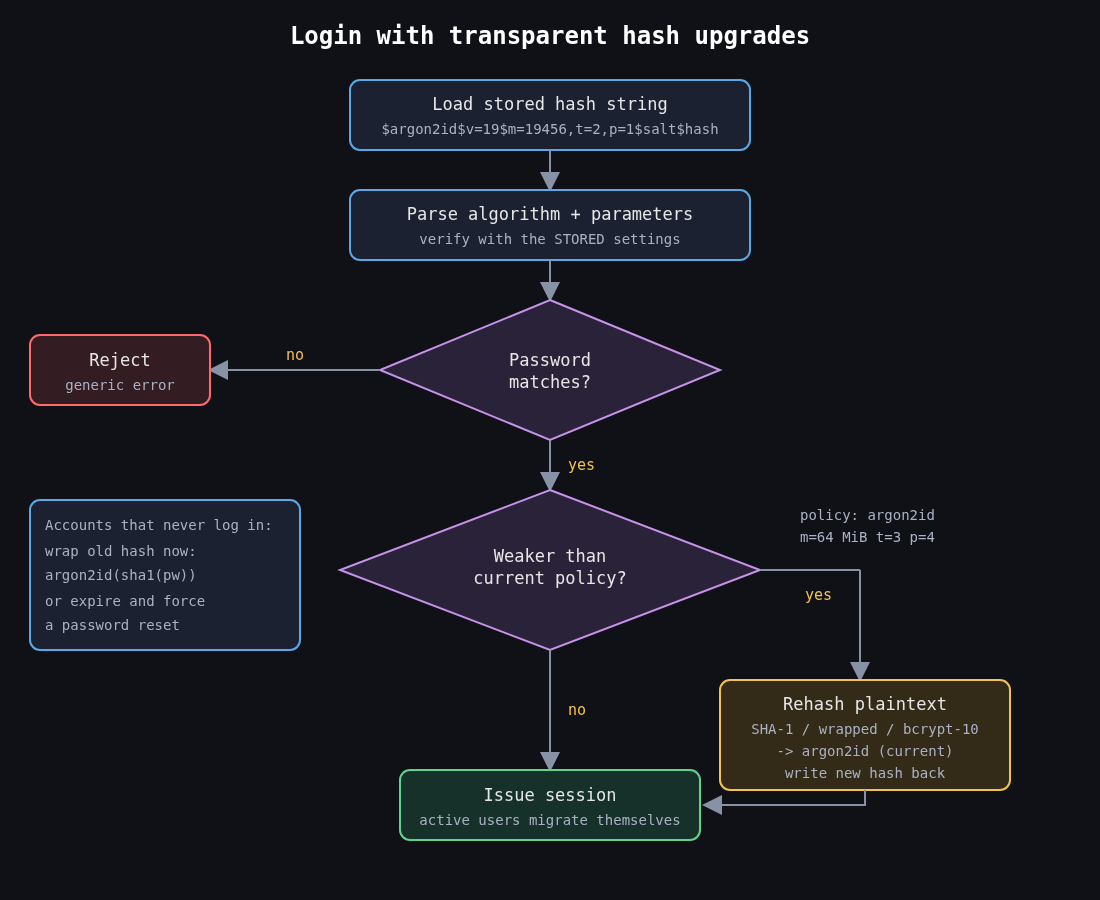
    Flowchart: parse the stored hash parameters, verify the password, then rehash to current Argon2id policy if the stored parameters are weaker, before issuing a session

    A password hash has one job: make each guess expensive for someone who has stolen your database. General purpose hashes like SHA-256 are designed to be fast, and a single modern GPU computes billions of them per second. When LinkedIn’s 2012 dump of unsalted SHA-1 hashes surfaced publicly in 2016 with roughly 117 million credentials, most of it was cracked quickly. Salting would have stopped the precomputed table attacks. It would not have helped much against brute force, because each individual guess still cost almost nothing.

    Adobe’s 2013 breach is the other cautionary tale. Those passwords were encrypted with 3DES in ECB mode, not hashed, so identical passwords produced identical ciphertext and the plaintext password hints sitting next to them did the rest. Encryption is the wrong tool here. You never need to recover a password, only to check one.

    So the requirements are a unique random salt per password and a function that is deliberately slow and, ideally, memory hungry. Memory hardness matters because GPUs and ASICs have lots of compute but limited fast memory per core. Forcing every guess to touch tens of megabytes destroys their parallelism advantage.

    The three you should consider

    bcrypt dates from 1999 and is still fine. It’s CPU hard with a tunable cost (each increment doubles the work), it’s in every language, and it has a long track record. It has two sharp edges. It is not memory hard in any meaningful sense (it uses about 4 KB), and it silently ignores input past 72 bytes.

    The second one has caused a real incident. In late 2024 Okta disclosed that its AD/LDAP delegated authentication cache keys were bcrypt hashes of the user ID, username and password concatenated together. With a username long enough (52 characters or more), the password fell past the 72 byte cutoff, so a cached login could succeed with any password. Nothing was wrong with bcrypt’s math. The input simply got truncated without an error.

    scrypt (RFC 7914) was the first widely used memory hard function. It’s tunable through N (CPU/memory cost), r (block size) and p (parallelism), and memory use is roughly 128 x N x r bytes. N=2^17, r=8, p=1 works out to 128 MiB per hash, which is the OWASP baseline.

    Argon2id won the Password Hashing Competition in 2015 and is specified in RFC 9106. It takes memory in KiB, a number of passes, and a degree of parallelism. The “id” variant mixes data independent and data dependent memory access, giving reasonable resistance to both side channel and GPU attacks. It’s my default for anything new.

    PBKDF2 stays on the list only because FIPS-140 environments sometimes require it. If you’re stuck with it, OWASP currently says 600,000 iterations of HMAC-SHA256. It is not memory hard, so treat it as the compliance option, not the good one.

    Choosing parameters with real numbers

    The published recommendations are a floor, not a target. OWASP’s Password Storage Cheat Sheet lists Argon2id at a minimum of m=19 MiB, t=2, p=1, with equivalent tradeoffs like m=46 MiB, t=1. RFC 9106 is more aggressive: its second recommended option is t=3, m=64 MiB, p=4, and the first option uses 2 GiB, which is meant for settings like disk encryption rather than a login endpoint.

    What I actually do is benchmark on the production hardware and work backwards from two constraints. The first is latency: how long can a login take before users notice? Somewhere around 100 to 500 ms of hashing is usually acceptable. The second is concurrency: memory cost times the number of simultaneous logins you need to survive. At 64 MiB per hash, 50 concurrent logins need 3.2 GiB just for hashing. Get that wrong and a credential stuffing wave becomes an out-of-memory event on your auth service.

    The reference argon2 CLI makes the measurement easy. Note that -m is the base-2 log of the memory in KiB, so 16 means 64 MiB.

    $ echo -n 'correct horse battery staple' | argon2 somesaltvalue -id -t 3 -m 16 -p 4
    Type:           Argon2id
    Iterations:     3
    Memory:         65536 KiB
    Parallelism:    4
    Hash:           ...
    Encoded:        $argon2id$v=19$m=65536,t=3,p=4$...
    0.183 seconds

    Increase memory first until you hit your concurrency budget, then add passes until you hit your latency budget. Memory is what hurts attackers most.

    Store parameters with the hash, and rehash on login

    The encoded string format (the $argon2id$v=19$m=65536,t=3,p=4$salt$hash form above) carries the algorithm and parameters alongside the salt and hash. That’s what makes upgrades possible. You verify with whatever parameters the stored hash says, and if they’re weaker than your current policy, you rehash the plaintext you just verified and write the new value back.

    from argon2 import PasswordHasher
    from argon2.exceptions import VerifyMismatchError
    
    ph = PasswordHasher(time_cost=3, memory_cost=65536, parallelism=4)
    
    def login(user, password):
        try:
            ph.verify(user.password_hash, password)
        except VerifyMismatchError:
            return False
        if ph.check_needs_rehash(user.password_hash):
            user.password_hash = ph.hash(password)
            user.save()
        return True

    Active users migrate themselves within a few months. For the long tail of accounts that never log in, you have two options. You can wrap the old hash (store argon2id(old_sha1_hash) and verify by computing both layers), which upgrades everyone immediately without needing their passwords. Or you can expire those passwords and force a reset. I’ve used wrapping for legacy MD5 and SHA-1 tables and it works well, as long as you mark which rows are wrapped.

    Peppers and pre-hashing

    A pepper is a secret key applied to every password, kept outside the database, ideally in a KMS or HSM. The common construction is to HMAC the password with the pepper before hashing it. If an attacker gets a SQL injection dump but not the application secrets, the hashes are useless to them. The cost is operational: rotating a pepper means keeping old keys around and tracking which one each hash used.

    Pre-hashing is also how people get around bcrypt’s 72 byte limit, and it’s easy to get wrong. If you bcrypt a raw SHA-256 digest, the binary output can contain NUL bytes that some bcrypt implementations treat as the end of the string. Base64 encode the digest first. And use HMAC with a pepper rather than a bare hash, otherwise an attacker holding a separate leak of unsalted SHA-256 hashes can test them directly against your bcrypt values without cracking anything, a technique known as password shucking.

    The cleaner answer is to use Argon2id and not need any of this. If you’re on bcrypt and staying there, at least reject or explicitly handle inputs over 72 bytes so the truncation is never silent.

    What I’d check on any existing system

    Open the users table and look at a few hash prefixes. $2b$10$ is bcrypt at cost 10, $argon2id$ tells you parameters inline, and a bare 40 or 64 character hex string is a fast hash you need to fix this quarter. Then check whether the login path rehashes, whether the memory cost was ever benchmarked against peak concurrency, and whether anything concatenates fields before passing them to bcrypt. Most of what I find in reviews sits in that last check.

    Storing passwords well protects users after a breach. Next in this series is about making a stolen or phished password much less useful in the first place, which means MFA that holds up against phishing.

    Other parts: Part 2: MFA that survives phishing, Part 3: OAuth 2.0 vs OpenID Connect, Part 4: Session management.
  • Horcrux dev log 3: back after nine months, 92 failed CI runs

    Horcrux dev log 3: back after nine months, 92 failed CI runs

    Part 3 in the Horcrux dev log series.

    Backdated, written in November 2026 from git and CI records. Part 2 stopped at an unfinished ISO on December 31, 2025.

    I came back on September 24, 2026 with two goals: get CI to really run, and build Horcrux the Gentoo way.

    The Gentoo goal came from a mistake. At some point the Dockerfile had turned into standard Rust boilerplate: FROM rust, cargo build, FROM debian-slim. It had drifted into boilerplate that ignored what the project is for. I fixed it on September 24 and wrote a rule into the repo notes so it can’t come back. The rule in the repo notes reads:

    A Dockerfile doing FROM rust:* -> cargo build -> FROM debian:*-slim
    is wrong. It is a regression. Fixed once already on 2026-09-24.

    Now the Dockerfile builds through real Portage against the project’s own ebuild, and the ebuild is the canonical install path.

    The numbers

    Pulled from the Forgejo API, September 24 to 30:

    workflow runs: 121
      success 12
      failure 92
      cancelled 11
      skipped 6
    ci.yml: 8 success, 71 failure
    docs.yml: 4 success, 19 failure

    88 commits that week, a lot of them fixes for whatever the last run complained about.

    What kept breaking

    The ebuild first. It depended on virtual/rust, which doesn’t exist (the package is dev-lang/rust), so emerge said “there are no ebuilds to satisfy”. dev-util/trunk doesn’t exist either, so the UI bundler gets installed with cargo during the build. qemu’s REQUIRED_USE says vte? ( gtk ) and I’d enabled vte alone. The Xen tools ebuild in that Gentoo snapshot died in src_prepare on an unset version variable; Horcrux only does KVM, so I dropped the Xen flag instead of fighting it. A pile of qemu and spice USE flags dead-ended in a masked libglvnd, and a headless VM host has no use for audio or GL anyway.

    Then the runners. Actions that weren’t mirrored on the registry my Forgejo uses. upload-artifact v4 not supported (“GHESNotSupportedError”). A runner with a full disk. A clippy step killed by the runner. A 30 minute ephemeral timeout that killed legitimate Gentoo builds. A full emerge that hit a 3 hour limit until I gave the CI image light USE flags. Several commit messages just say “retrigger” because the last failure was the infrastructure and not the code.

    Fake stuff that came out

    Real tests started finding placeholders. The login form wasn’t wired to the auth API. Disk usage in the metrics was a hardcoded 65%; it now reads statvfs. The Kubernetes join code accepted a made-up CA cert hash and now refuses it. HA fencing for IPMI, iLO, iDRAC and SNMP PDUs, parallel volume restore and live-migration pre-flight checks were stubs and got real code on the 30th. I don’t know yet how any of that behaves on actual hardware. release.yml only built x86_64 although the README claimed three architectures, so it now cross-compiles aarch64 and riscv64.

    On the 25th and 26th the API integration suite reached 22 of 22. It’s the first green test run I can find in the history.

    State

    The Gentoo build works in CI with trimmed USE flags, the tests run, and about one run in ten was green. The README still overpromised, and I rewrote its status line on October 21 (part 5).

    Design decisions

    Gentoo first. My reason is freedom to choose. USE flags are the main part: they let an installer choose which virtualization backends, container runtimes and NAS protocols get compiled in, and the repo notes call that the main advantage over Proxmox. Compiling for specific hardware is the secondary reason. For background, I was a Debian developer from 1999 to 2006 and I’ve used Gentoo since. I’m blunt about it in the repo notes: generic Debian or Ubuntu conventions are the wrong default here.

    Dropping Xen. The commit says Horcrux is a headless KVM-only VM host and has no need for Xen guest support. The same reasoning removed audio and GL from qemu: no local display on a headless host.

    Architectures: amd64, arm64 and riscv64. The README dropped ppc64le the same day as out of scope. That’s my call, and I don’t have the reason written down. The riscv64 notes do say it needs real hardware for validation.

    Light USE flags in CI: the full emerge hit a 3 hour limit, so the CI smoke-test image builds with fewer flags. A speed trade, and it means CI doesn’t build the full-feature package.

    Other parts: Part 1, Part 2, Part 4, Part 5, Part 6. The series continues with the latest Horcrux dev log post.

  • Patronus dev log 3: back in September, with 43 red CI runs and no green ones

    Patronus dev log 3: back in September, with 43 red CI runs and no green ones

    Part 3 in the Patronus dev log series.

    Backdated, written in November 2026 from git and CI records. Part 2 ended with nine months of silence.

    I picked Patronus back up the same day as Horcrux, September 24, 2026. The first job was the same: make CI run. Patronus got a Rust CI workflow that day (fmt, clippy, tests, an eBPF check, a full-workspace build). It failed. Over September 24 to 30 the Forgejo record shows 57 runs: 43 failures, 7 cancelled, 7 skipped, 0 successes. Of those, rust-ci.yml had 42 failures.

    The first failures were the dull kind: a missing libmnl-dev, a missing libelf, no linker on the runner image, and a real bug. An eBPF map-create call took its name as i8 and needed u8, which was blocking the detection and CNI crates from building at all.

    The Dockerfile again

    Same mistake as in Horcrux, found the same day. The Dockerfile had become a generic FROM rust build on a Debian slim image. The repo notes now say so, in short:

    A generic FROM rust -> cargo build -> debian slim Dockerfile is wrong.
    It crept in once and was fixed on 2026-09-24.

    Patronus builds through real Portage against its own overlay. The ebuild kept breaking, in familiar ways: virtual/rust doesn’t exist (same bug as Horcrux, the commit says so), acct-user and acct-group variable names were wrong, a USE flag was called carp in the code and ucarp in IUSE, the meta USE flags defaulted on with no sub-backend, and the ebuild forwarded cargo features that don’t exist (aliases, tc, prometheus). Building Rust from source inside the Docker build took 2 hours 45 minutes, so I switched to dev-lang/rust-bin. And the Gentoo Docker build got capped at 60 minutes and made non-blocking while I sorted it out.

    On the 29th the installer picked up root-on-ZFS, preferred when the ZFS tools are present.

    Design decisions

    Gentoo and USE flags: Gentoo is the core design point. My reason is freedom to choose. USE flags come first because they let you pick which features (web UI, eBPF/XDP, SD-WAN, detection, cloud integrations) get compiled in, and the repo notes call that the main advantage over pfSense and OPNsense. Hardware specific compiles are the second reason. A container build must pass USE flags through to emerge rather than compile a fixed set.

    rust-bin over source Rust: the from-source build took 2h45m (the commit’s number).

    Architecture: the repo notes have one rule: one SQLite store as the single source of truth, one “Applier” per subsystem, one apply step at boot, and no extra in-memory list, fixture or config file that only one process knows about.

    State on September 30

    57 runs, none green, and about 60 commits. The Gentoo build was non-blocking at the end of the week and still no run was green.

    Other parts: Part 1, Part 2, Part 4, Part 5.