
The 1-RTT handshake and what changed
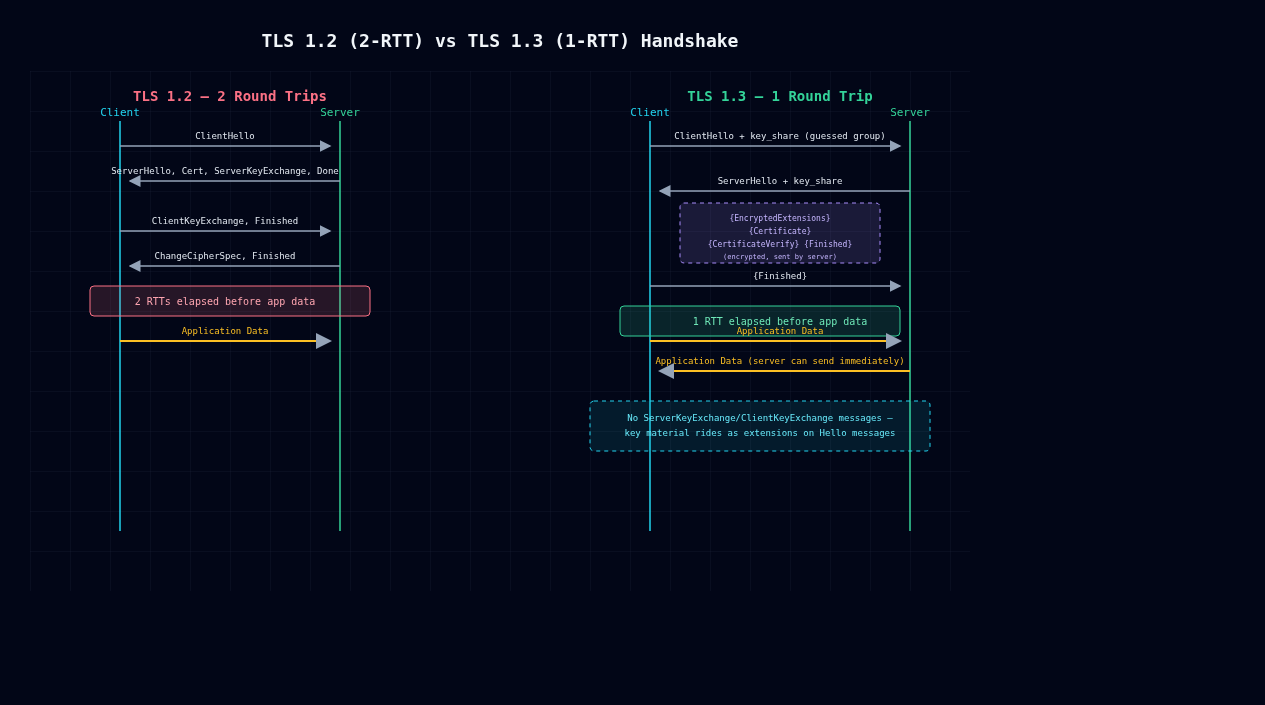
TLS 1.3 (RFC 8446, finalized August 2018) isn’t a tuning pass on TLS 1.2. It’s a different protocol wearing the same name. The headline feature is a 1-RTT handshake instead of 2-RTT, but the interesting part is why that was even possible: an entire class of key exchange got deleted, renegotiation got deleted, and forward secrecy stopped being optional. Here’s what changed on the wire.
TLS 1.2’s 2-RTT problem
A full TLS 1.2 handshake looks like this:
Client                                               Server
  ClientHello  (cipher suites, supported groups, random) -->
                                              <-- ServerHello (chosen cipher)
                                              <-- Certificate
                                              <-- ServerKeyExchange (if DHE/ECDHE)
                                              <-- ServerHelloDone
  ClientKeyExchange -->
  [ChangeCipherSpec] -->
  Finished -->
                                              <-- [ChangeCipherSpec]
                                              <-- Finished
  Application Data <-->
The client sends a hello, the server replies with everything needed to pin down the cipher and key exchange, and only then can the client respond with its key material and a Finished message. Application data doesn’t move until after that second round trip. On a connection with 80ms RTT to a distant CDN edge, that’s 160ms burned on negotiation before TLS has done anything useful.
The root cause is ordering: the client has no idea which key exchange group or cipher the server will pick until ServerHello shows up, so it can’t send a key share in the first flight. It’s stuck waiting.
TLS 1.3’s fix: guess the group instead of negotiating it
TLS 1.3 collapses the handshake by having the client guess which (EC)DHE group the server prefers and send a key share speculatively, right in the ClientHello:
Client                                               Server
  ClientHello
    + key_share (e.g. x25519 public value)
    + supported_versions, signature_algorithms -->
                                              <-- ServerHello
                                                    + key_share
                                              <-- {EncryptedExtensions}
                                              <-- {Certificate}
                                              <-- {CertificateVerify}
                                              <-- {Finished}
  {Finished} -->
  Application Data <-->                       <-- Application Data
Everything in {} is encrypted. The server derives handshake traffic keys from its own ephemeral share plus the client’s key_share immediately after ClientHello arrives, so even the certificate exchange is now confidential. That closes a leak that existed in 1.2 for years: certs used to go over the wire in cleartext, which meant any passive eavesdropper could see exactly which server you were talking to. Because the client already sent a key share up front, the server can finish the key agreement and start pushing encrypted application data in its very first response. The client, once it has ServerHello and Finished, can start sending data too, no extra round trip needed to acknowledge anything. That’s your 1-RTT.
If the client guesses wrong (rare these days since x25519 is close to universal), the server sends a HelloRetryRequest and you’re back to something like 2-RTT. But that’s the exception path, not what happens on a normal connection.
You can watch this happen directly:
$ curl -v --tlsv1.3 https://example.com 2>&1 | grep -i 'TLS\|SSL connection'
* TLSv1.3 (OUT), TLS handshake, Client hello (1):
* TLSv1.3 (IN), TLS handshake, Server hello (2):
* TLSv1.3 (IN), TLS handshake, Encrypted Extensions (8):
* TLSv1.3 (IN), TLS handshake, Certificate (11):
* TLSv1.3 (IN), TLS handshake, CV (15):
* TLSv1.3 (IN), TLS handshake, Finished (20):
* TLSv1.3 (OUT), TLS handshake, Finished (20):
* SSL connection using TLSv1.3 / TLS_AES_256_GCM_SHA384
Notice there’s no ServerKeyExchange or ClientKeyExchange message type anymore. Key exchange data rides inside the Hello messages as an extension (key_share) instead of being its own standalone handshake message.
Static RSA key exchange is gone, and good riddance
TLS 1.2 allowed TLS_RSA_WITH_* cipher suites, where the client just encrypts a premaster secret directly with the server’s RSA public key. No Diffie-Hellman anywhere. This was fast, one asymmetric operation and no DHE math, but it was a disaster for confidentiality: if the server’s private key is ever compromised, subpoenaed, or pulled out via something like Heartbleed, every past session a passive adversary ever recorded becomes decryptable after the fact. There’s no forward secrecy here, because one static key derives every session’s secret.
RFC 8446 rips static RSA key exchange out entirely. TLS 1.3 only supports (EC)DHE-based exchange, plus PSK for resumption, which I’ll get to below. Every handshake negotiates a fresh ephemeral key pair, so compromising the server’s long-term signing key lets an attacker impersonate the server from that point forward, but it buys them nothing against traffic captured earlier. Forward secrecy isn’t a cipher-suite setting you can accidentally misconfigure away anymore. It’s just how the protocol works now.
Renegotiation is gone too. TLS 1.2’s renegotiation, re-running the handshake mid-connection to rotate keys or ask for a client cert, was the root cause of CVE-2009-3555, a plaintext-injection bug that needed the RFC 5746 patch as a partial band-aid. TLS 1.3 replaces that one general-purpose “redo the whole handshake” hammer with two narrower tools: post-handshake authentication (a CertificateRequest sent after the handshake, for mTLS-style client cert checks) and a dedicated KeyUpdate message for rotating keys.
0-RTT resumption: speed, paid for with replay risk
For repeat connections, TLS 1.3 offers 0-RTT via PSK resumption. The client reuses a session ticket from an earlier connection and sends encrypted application data in the very first flight, before the server has said a word back:
Client                                               Server
  ClientHello + early_data + psk extension
  (encrypted with early_data_key)
  Application Data (0-RTT) -->
                                              <-- ServerHello, ... Finished
  Application Data <-->
That’s genuinely zero round trips of latency before data moves, which is great for a mobile client reconnecting to a server it already knows. The catch: 0-RTT data has no replay protection. The client sends it before the handshake finishes, specifically before the server’s Finished message, which is the thing that actually proves liveness and ties the exchange together. A network-positioned attacker can just capture that first flight and replay it verbatim. The server has no way to tell a replay apart from a legitimate retransmission at that layer, full stop.
RFC 8446 Section 8 doesn’t try to fix this cryptographically. It pushes the problem up to the application: only use 0-RTT for idempotent requests (safe GETs, not POST /transfer-funds), and let servers implement their own anti-replay measures, single-use tickets, bounded replay caches, that sort of thing. Those measures claw back some of the latency win in exchange for safety. I’ve seen teams enable 0-RTT and forget this tradeoff exists, then get surprised when a retry storm double-charges something. In practice, most production setups (NGINX, HAProxy, Cloudflare) either disable 0-RTT outside of static content or require the application to opt in per request.
What this means for your setup
If you’re terminating TLS yourself, not sitting behind a CDN, confirm your stack is actually negotiating 1.3 and not quietly falling back to 1.2 for compatibility reasons that stopped mattering years ago. Run openssl s_client -connect host:443 -tls1_3 and check for Protocol: TLSv1.3 in the output.
Drop any RSA key-exchange cipher suites still sitting in your 1.2 fallback config. They’re exactly the forward-secrecy hole TLS 1.3 was built to close.
If you turn on 0-RTT, go audit which endpoints can actually receive early data. Most servers let you scope this. Default to “none” until you’ve actually confirmed the endpoint is idempotent, not just assumed it.
TLS 1.3 isn’t TLS 1.2 with a speed boost bolted on. An entire category of key exchange is gone, renegotiation got replaced with purpose-built mechanisms, and there’s a new performance feature that trades away specific security guarantees for latency. Know which guarantees before you flip it on.
Leave a Reply
You must be logged in to post a comment.